Log auditing and hours of service compliance
Hours of service is the area where carriers most often believe they are compliant and most often are not. Logs are checked line by line, against the supporting documents that prove or disprove them.
Why logs generate so many findings
NSC Standard 9 sets out how many hours a commercial driver may be on duty and driving, the cycles available, the requirement to complete daily logs and the records a carrier has to keep. It is the standard most carriers think they have covered.
The problem is rarely the driving hours themselves. It is the gap between the log and everything else. Fuel receipts, bills of lading, dispatch records, gate times and GPS data all tell a story, and an auditor compares that story to the log. Where they disagree, the log loses.
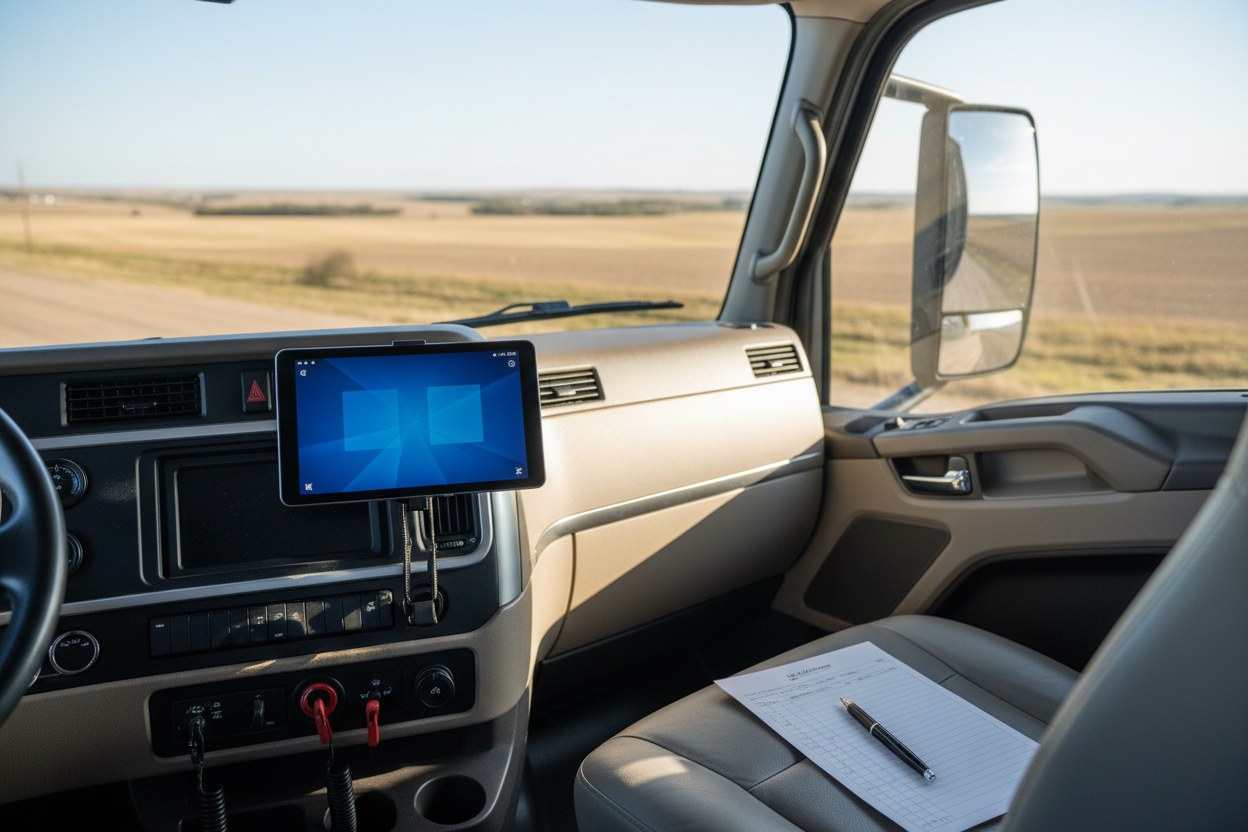
Moving to electronic logging removed some errors and introduced others. Unassigned driving time, unresolved edit requests, personal conveyance used as a catch all, and drivers logged into the wrong profile all show up clearly in ELD data, which means they show up clearly to an auditor too.
A log audit finds those patterns while they are still a coaching conversation rather than a finding.
What gets checked
- Daily logs and ELD records for the period sampled, reviewed for accuracy and completeness rather than just for presence.
- Cycle compliance and whether cycle switches were made and recorded correctly.
- Supporting documents matched against the logs to find the discrepancies an auditor would find.
- Unassigned driving time and whether it is being reviewed and resolved.
- Edits and annotations, including whether driver certification of edits is actually happening.
- Personal conveyance and yard move usage, a frequent source of findings.
- Off duty and sleeper berth entries where the pattern does not match the operation.
- Your own monitoring process. Carriers are expected to be auditing their own logs. Having no monitoring is itself a finding.
- Record retention, including whether you can actually produce the records for the required period on request.
How a log audit runs
Scope call
Fleet size, whether you run ELD or paper, which cycles your drivers use, and whether there is a specific incident behind the enquiry.
Data pull
A sample period selected the way an auditor would select it, plus the matching supporting documents. Most ELD platforms can export what is needed directly.
Line by line review
Logs checked for compliance and cross checked against supporting documents to surface the discrepancies.
Pattern report
Findings grouped by driver and by type, so you can see whether you have a training problem, a dispatch pressure problem or a systems problem.
Fix and coach
A corrective plan covering driver coaching, dispatch practice and the internal monitoring routine that keeps it from recurring.
Common questions
How far back does a log audit go?
It depends on the reason for the review and the retention period that applies to your operation. A routine health check usually samples a recent period. A review prompted by an audit notice or a serious incident normally needs to match the period the province will examine.
We run ELDs. Are we not automatically compliant?
No. An ELD records what happened, which is a genuine improvement, but it does not stop a violation from happening and it does not resolve unassigned driving time or edit requests for you. Carriers who assume the device handles compliance tend to have the most unresolved items sitting in the system.
Can you audit paper logs?
Yes. Where paper logs are still permitted for your operation they are reviewed the same way, against the same supporting documents.
Will you tell us which drivers are the problem?
Yes. Findings are grouped by driver, because that is how you act on them. The report is written to support coaching, not to build a disciplinary file, but the information is there either way.
Other services
NSC Audits
Facility audits and new carrier compliance reviews
Learn moreCOR Audits
Certificate of Recognition audits through AMTA, certification to renewal
Learn moreMaintenance Reviews
NSC Standard 11 and 11B, CVIP and repair records
Learn moreCarrier Profile Services
Read it, fix it, and keep it out of the intervention range
Learn moreIncident Investigation
Collisions and near misses investigated to a standard that holds up
Learn moreCommercial Driver Training
Practical training that stands up in an audit
Learn more
Book this review before the province books one for you.
A short scope call costs nothing and usually tells you straight away whether you have a problem worth paying to fix.